Fabrication
Welcome to Ganesh Fabrotech Pvt Ltd, we specialize in providing high-quality fabrication solutions tailored to meet your specific needs. With years of experience in the industry, our team of skilled professionals is dedicated to delivering precision-engineered products that exceed expectations.
Our fabrication process is a fusion of advanced technology and skilled craftsmanship. We utilize cutting-edge machinery and software to transform raw materials into exquisite finished products that exceed your expectations.
At Ganesh Fabrotech Pvt Ltd, we understand that each project is unique. That’s why we collaborate closely with our clients from concept to completion, ensuring that every detail aligns with your vision. Our team of experienced fabricators is dedicated to achieving perfection in every project, no matter the scale or complexity.
Quality is at the forefront of everything we do. We source only the finest materials and employ rigorous quality control measures throughout the fabrication process. Rest assured, your project will meet the highest standards of durability, functionality, and aesthetics.
From prototypes to production runs, we have the flexibility and capability to handle any project with precision and efficiency. Whether you’re a designer, architect, engineer, or entrepreneur, we’re here to turn your ideas into reality.
With our commitment to excellence and customer satisfaction, you can trust us to deliver superior fabrication services that meet your exact specifications.
Contact us today to discuss your fabrication needs and let us bring your vision to life!
Welding Expertise
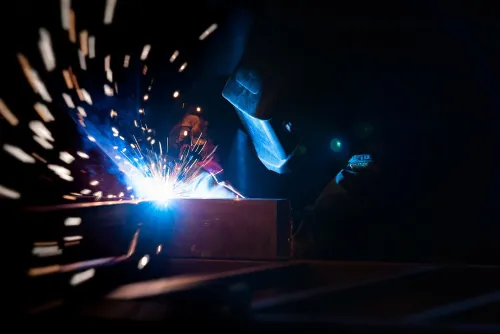
Gas Metal Arc Welding (GMAW/MIG)
Gas Metal Arc Welding (GMAW/MIG)
Gas tungsten arc welding (GTAW), also known as tungsten inert gas (TIG) welding, is an arc welding process that uses a non-consumable tungsten electrode to produce the weld. The weld area and electrode are protected from oxidation or other atmospheric contamination by an inert shielding gas (argon or helium). A filler metal is normally used, though some welds, known as autogenous welds, or fusion welds do not require it.
When helium is used, this is known as heliarc welding. A constant-current welding power supply produces electrical energy, which is conducted across the arc through a column of highly ionized gas and metal vapors known as a plasma. GTAW is most commonly used to weld thin sections of stainless steel and non-ferrous metals such as aluminum, magnesium, and copper alloys. The process grants the operator greater control over the weld than competing processes such as shielded metal arc welding and gas metal arc welding, allowing for stronger, higher quality welds. However, GTAW is comparatively more complex and difficult to master, and furthermore, it is significantly slower than most other welding techniques. A related process, plasma arc welding, uses a slightly different welding torch to create a more focused welding arc and as a result is often automated.
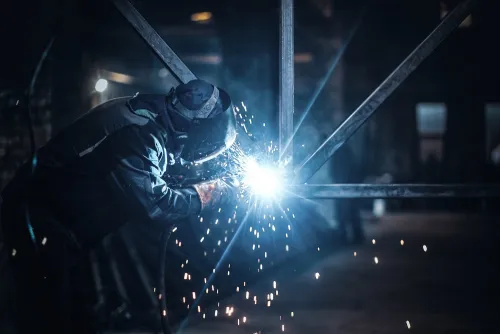
Gas Tungsten Arc Gas Welding (GTAW/TIG)
Gas Tungsten Arc Gas Welding (GTAW/TIG)
Shielded metal arc welding (SMAW), also known as manual metal arc welding (MMA or MMAW), flux shielded arc welding[1] or informally as stick welding, is a manual arc welding process that uses a consumable electrode covered with a flux to lay the weld.An electric current, in the form of either alternating current or direct current from a welding power supply, is used to form an electric arc between the electrode and the metals to be joined.
The workpiece and the electrode melts forming a pool of molten metal (weld pool) that cools to form a joint. As the weld is laid, the flux coating of the electrode disintegrates, giving off vapors that serve as a shielding gas and providing a layer of slag, both of which protect the weld area from atmospheric contamination. Because of the versatility of the process and the simplicity of its equipment and operation, shielded metal arc welding is one of the world’s first and most popular welding processes. It dominates other welding processes in the maintenance and repair industry, and though flux-cored arc welding is growing in popularity, SMAW continues to be used extensively in the construction of heavy steel structures and in industrial fabrication. The process is used primarily to weld iron and steels (including stainless steel) but aluminium, nickel and copper alloys can also be welded with this method
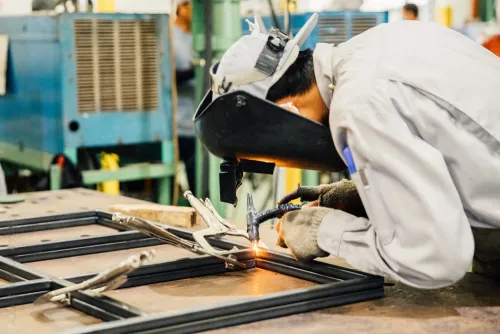
Shielded Metal Arc Welding (SMAW)
Shielded Metal Arc Welding (SMAW)
Shielded metal arc welding (SMAW), also known as manual metal arc welding (MMA or MMAW), flux shielded arc welding[1] or informally as stick welding, is a manual arc welding process that uses a consumable electrode covered with a flux to lay the weld.An electric current, in the form of either alternating current or direct current from a welding power supply, is used to form an electric arc between the electrode and the metals to be joined.
The workpiece and the electrode melts forming a pool of molten metal (weld pool) that cools to form a joint. As the weld is laid, the flux coating of the electrode disintegrates, giving off vapors that serve as a shielding gas and providing a layer of slag, both of which protect the weld area from atmospheric contamination. Because of the versatility of the process and the simplicity of its equipment and operation, shielded metal arc welding is one of the world’s first and most popular welding processes. It dominates other welding processes in the maintenance and repair industry, and though flux-cored arc welding is growing in popularity, SMAW continues to be used extensively in the construction of heavy steel structures and in industrial fabrication. The process is used primarily to weld iron and steels (including stainless steel) but aluminium, nickel and copper alloys can also be welded with this method.
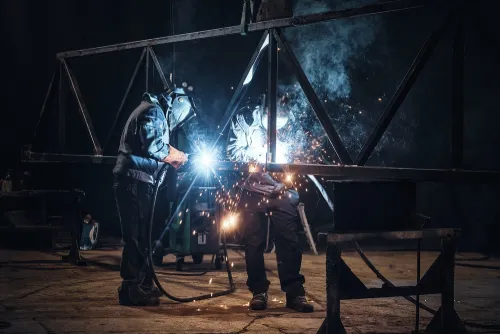
Flux Cored Arc Welding (FCAW)
All types of Fabrication in various alloys: Our skilled, certified welding staff has years of welding experience and can provide a full range of services ranging from structural and plate welding to light gauge welding. We weld on most alloys, including steel, stainless, aluminium, and cast iron. Our state-of-the-art facility is well equipped to take on all types of welding challenges.
We maintain WPS, PQR records for same.